We manufacture custom C1100/C1020 pure copper heat sinks, cold plates and bonded-fin assemblies using extrusion, skiving, CNC machining, vacuum brazing and welding. Our copper thermal components serve AI server GPUs, CPUs, chipsets, memory modules, EV power electronics, IGBT modules, LED systems and industrial power supplies. Engineering teams use us for DFM review, rapid CNC prototypes, tooling, first article inspection, PPAP documentation, thermal resistance testing and repeat production. From prototype to production, we support application-specific fin geometry, base thickness and mounting features. Quality is controlled under ISO9001 and IATF16949, with RoHS and REACH compliance, nickel plating, tight tolerances and reliable global delivery. Send your STEP, IGES, DWG or PDF drawing for a process recommendation and a quotation within 24 hours.
Copper heat sink fabrication and design decisions drive more than a line item in your BOM. Across comparable copper heat sink geometries, the gap between a well-matched process and a mismatched one routinely reaches 2–5× in total program cost, while thermal performance differences rarely justify the spread. The engineering rule is straightforward: specify the simplest process that meets your thermal requirement. Over-engineering a heat sink into CNC machining when extrusion or skiving would suffice is one of the most common cost errors we see in incoming drawings.
The matrix below puts five copper heat sink processes side by side on the variables that actually drive procurement decisions. Each row is followed by a short decision section explaining when to select that process — and when to rule it out.
| Process | Best for | Fin geometry limit | Tooling | Unit cost signal | Prototype-friendly |
| Extruded copper | Long, constant-cross-section profiles at volume | Aspect ratio up to ~15:1; fin thickness typically ≥1.0 mm | Die required; $800–$3,500 depending on profile | Lowest at 5,000+ pcs | No — die lead time dominates |
| Skived fin copper | High heat flux, compact footprint, forced air | Fin thickness down to ~0.15 mm; aspect ratio up to 60:1 | Blade tooling; $800–$2,000 | Medium at 1,000–5,000 pcs; drops with volume | Moderate — same tool cuts each fin |
| CNC machined copper | Prototypes, complex geometry, integrated mounting features | Fin thickness limited by cutter diameter; typical minimum wall 1–3 mm | None to $1,200 | Highest per unit at volume; no tooling amortization | Yes — fastest iteration |
| Vacuum brazed / welded copper | Cold plates, liquid cooling, multi-part assemblies | Internal micro-channels and manifold geometries possible | Fixture + furnace cycle; no die | Moderate; batch economics | Yes — assembly-level prototyping |
| Bonded fin copper | High fin aspect ratios beyond extrusion/skiving; large footprints | Fin height/pitch less constrained by base material | Bonding fixture; low tooling | Premium vs. extruded or skived | Limited — bonding process qualification needed |
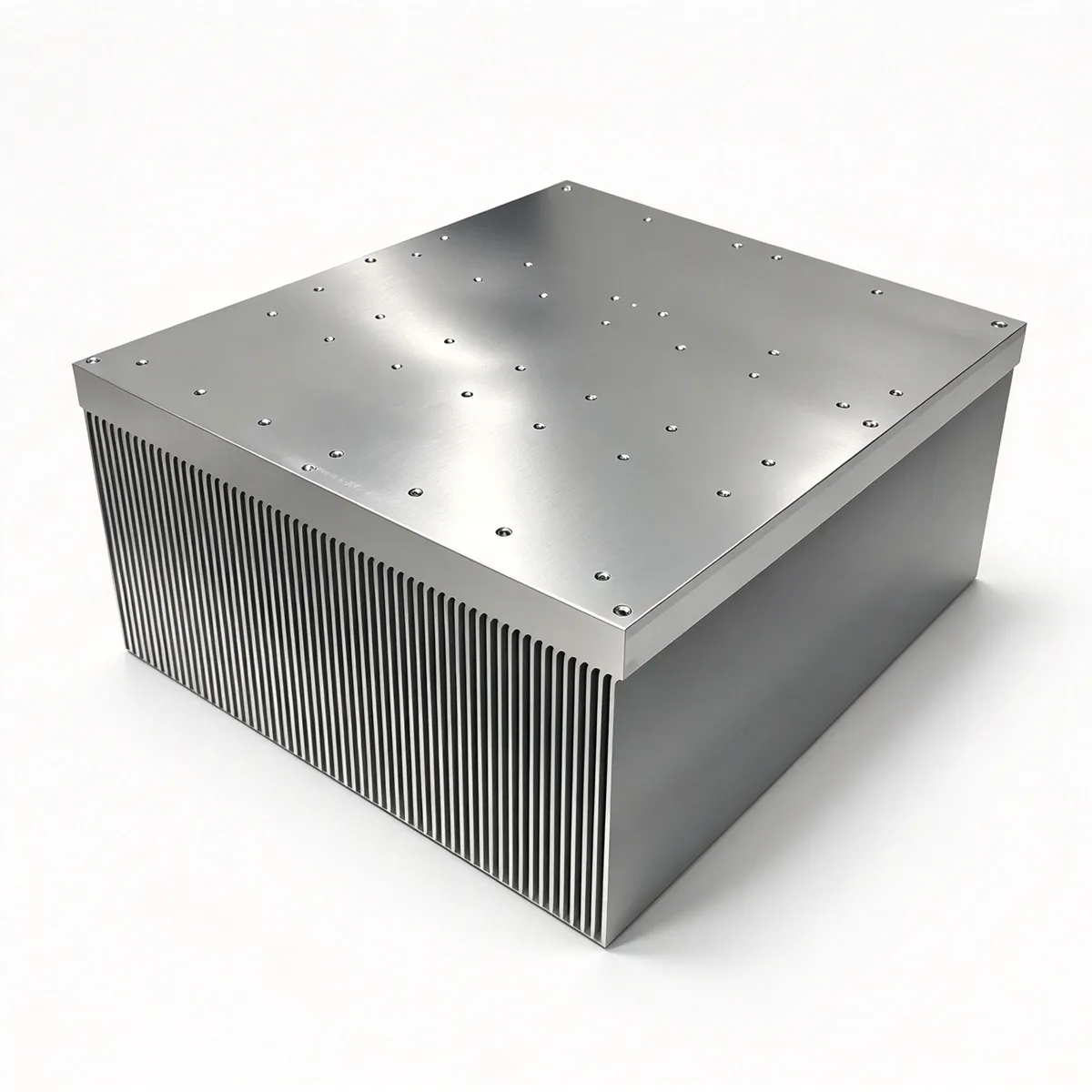
Select extrusion when the design has a constant cross-section and annual volume justifies a die. Copper heat sink extrusion forms base and fins as one piece with no thermal interface, but fin geometry is locked to the die: aspect ratios above roughly 15:1 and fin thickness below about 1.0 mm are impractical. Tooling runs $800–$3,500, and break-even against CNC typically sits at 2,000–5,000 pieces. If the drawing has pockets, varying fin heights, or interrupted profiles, send the STEP file — CNC finishing, skiving, or CNC may be the cleaner route.
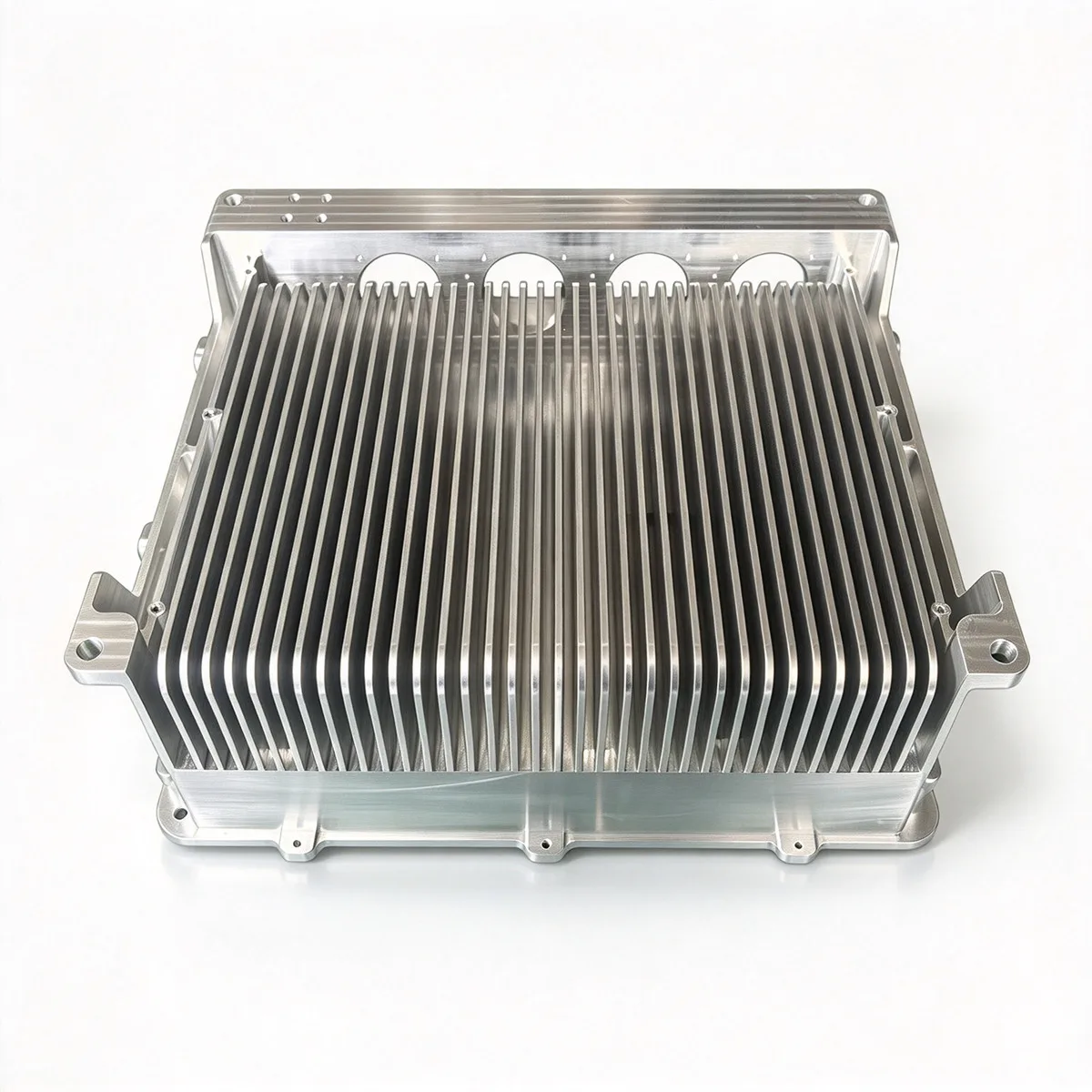
Specify skiving when heat flux is high, the footprint is tight, and you want to stay in air cooling. A blade peels fins from solid copper, leaving fin and base as one continuous structure with zero interface resistance. Skived copper heat sink fins reach 0.15 mm thickness, 50+ fins per inch, and 60:1 aspect ratios — beyond extrusion. Tooling is lower than extrusion, but unit cost is 2–4× extrusion baseline. Fins run in one direction, so airflow orientation must be fixed early. Above roughly 15–25 W/cm² in a compact envelope, quote skiving first.

CNC machining fits prototypes, low-volume builds, and geometries extrusion and skiving cannot produce — stepped bases, asymmetric fin fields, threads, and pockets in the thermal path. No die cost means design changes carry no tooling penalty, so every copper heat sink program should pass through CNC at prototype stage. The trade-off is unit economics: copper heat sink material waste can reach 60–80%, and machining time dominates as volume rises. Use CNC while the design is moving, when mounting surfaces need ±0.02 mm, or when volume is genuinely low.

When the requirement moves from air to liquid cooling or multi-component assemblies, copper heat sink welding and vacuum brazing become the reliability specification. Vacuum brazing joins base, fins, cover, and manifolds in one high-vacuum furnace cycle, producing a hermetic bond with leak rates below 1×10⁻⁹ mbar·l/s and first-pass leak yields above 99%. It suits copper micro-channel cold plates where internal fin geometry rules out mechanical assembly. Capillary flow needs 0.05–0.15 mm joint gaps, and batch cycles mean lead times in days per run. Select it when the fluid path is internal or pressure integrity is non-negotiable.
Copper heat sink material selection is a process decision before it is a thermal one. C1100 copper heat sink grades and C1020 copper heatsink both deliver thermal conductivity 400 W/mK in round numbers, so the choice turns on oxygen content, brazing environment, and cost.
C1100 is the default pure copper heatsink grade for extruded, skived, and CNC parts; C1020 is specified when vacuum brazing or reducing atmospheres above ~370°C rule out trace oxygen. The same logic applies to copper heat sink design: the process sets achievable copper heat sink fins, copper heat sink tolerance, and surface finish — not the alloy alone. The table below consolidates the specification decisions that change cost or thermal resistance.
| Specification area | Standard options | What it means for your design |
| Copper grade | C1100 (≥99.90% Cu, ~391 W/m·K) C1020 (≥99.95% Cu, ~394 W/m·K) | Use C1100 unless vacuum brazing or high-temp reducing atmosphere requires C1020; C1020 adds 5–10% material cost |
| Thermal conductivity | ~391–394 W/m·K (≈400 W/mK) | Both grades are ~1.7× aluminum; Grade choice rarely changes θsa — process choice does |
Fin geometry | Skived: 0.15–0.20 mm fins, 25–40:1 Extruded: 1.0–1.2 mm, ~12:1 CNC: ~0.5–1.0 mm, ~8:1 | Specify the loosest copper heat sink fins that meet the thermal model; tighter fins raise cost |
Tolerance & flatness | Extruded pitch ±0.10 mm skived ±0.05 mm CNC mounting face ±0.02 mm Base flatness to ±0.005 mm | Tighten copper heat sink tolerance only where TIM contact or mounting alignment requires it |
Surface finish | Electroless nickel 5–10 μm Electrolytic nickel Passivation Bare copper | Nickel plating copper heat sink parts is the baseline for humidity, automotive, and outdoor service; Keep TIM face at Ra 0.8–3.2 μm |
Certification | ISO9001 IATF16949 RoHS; REACH Mill cert per heat number | IATF16949 gates automotive/EV programs; RoHS and REACH need lot-level declarations |
Falcon HeatTech provides flexible manufacturing capabilities to transform engineered thermal designs into reliable cooling components. With advanced production technologies and experienced manufacturing teams, we support projects ranging from prototype development to volume production.
Manufacturing Capability
Process Advantages
Typical Applications
CNC Machined Heat Sinks
High precision machining for low volume complex structures, tight tolerances
Industrial electronics, power modules, custom thermal assemblies
Aluminum Extrusion Heat Sinks
Cost-effective production with lightweight profiles and optimized fin designs
Electronics cooling, LED systems, industrial equipment
Skived Fin Heat Sinks
High-density fins for increased surface area and improved heat dissipation
AI computing, high-power electronics, compact cooling systems
Die Casting Heat Sinks
Efficient production for complex geometries and high-volume applications
Automotive electronics, industrial equipment, consumer electronics
CNC Secondary Machining & Finishing
Precision features including mounting holes, threads, and assembly interfaces
Custom OEM thermal components, integrated cooling solutions
Vacuum Brazing & Thermal Assembly
Advanced joining solutions for integrated thermal structures
Power electronics, high-performance thermal systems

Need a custom heat sink solution? Let our engineering team review your requirements.
Falcon HeatTech supports projects from initial design validation to full-scale production, offering flexible heat sink prototyping services, small-batch manufacturing, and high-volume OEM production. Our production capabilities help customers move efficiently from early-stage development to stable manufacturing.

By combining engineering expertise with manufacturing capabilities, we help customers validate designs, refine product performance, and scale production according to project requirements.
Developing a custom heat sink requires close coordination between thermal requirements, product design, and manufacturing considerations. Falcon HeatTech follows a structured engineering workflow to help customers move from initial project evaluation to prototype validation and production.
Evaluate heat load, operating conditions, installation space, and target thermal performance to define project requirements.
Optimize product structures, select suitable materials, and assess custom heat sink fabrication feasibility based on performance and production requirements.
Build prototypes to verify design concepts, dimensions, assembly compatibility, and thermal performance.
Evaluate prototype results and refine the design to improve cooling efficiency, reliability, and manufacturing readiness.
Transition validated designs into OEM heat sink production, with controlled processes, consistent quality, and scalable supply.
Consistent quality is essential for reliable thermal performance and long-term product stability. Falcon HeatTech integrates quality control throughout the production process, helping ensure that every heat sink meets specified dimensional, material, and surface finish requirements.
From incoming material verification and in-process monitoring to final inspection, our quality control procedures help maintain manufacturing accuracy, product consistency, and reliable performance.

As an experienced custom heat sink supplier, Falcon HeatTech combines engineering expertise, manufacturing capabilities, and quality control to support global OEM customers. From prototype orders and small batches to ongoing production, we focus on consistent product quality, dependable delivery, and stable long-term supply.
Choosing the right manufacturing partner involves more than production capacity. It requires engineering expertise, process flexibility, and the ability to support projects from initial development through long-term production. Falcon HeatTech combines these capabilities to help customers develop reliable thermal management products and build lasting manufacturing partnerships.
We work closely with customer engineering teams to evaluate thermal requirements, optimize product structures, and improve manufacturability while balancing cooling performance, mechanical constraints, and cost considerations.
Our production capabilities support different project stages, from prototype development and small-batch orders to scalable production. We help customers select suitable processes based on product design, specifications, and volume requirements.
We emphasize material verification, process control, dimensional inspection, and final product checks to maintain consistent quality and support reliable product performance.
We collaborate with engineers, designers, and purchasing teams through responsive communication, coordinated project development, and dependable production support. Our goal is to build long-term partnerships that adapt to evolving product and manufacturing requirements.
Explore real-world manufacturing projects and technical insights to better understand heat sink design considerations, material selection, thermal performance, and production processes. Our case studies and engineering resources provide practical guidance to support product development, design evaluation, and thermal management decisions.
A compact electronics application required efficient cooling within a limited space. Falcon HeatTech optimized the heat sink design, balancing thermal performance, space constraints, and manufacturability. The final custom heat sink achieved reliable thermal performance and met all production requirements.
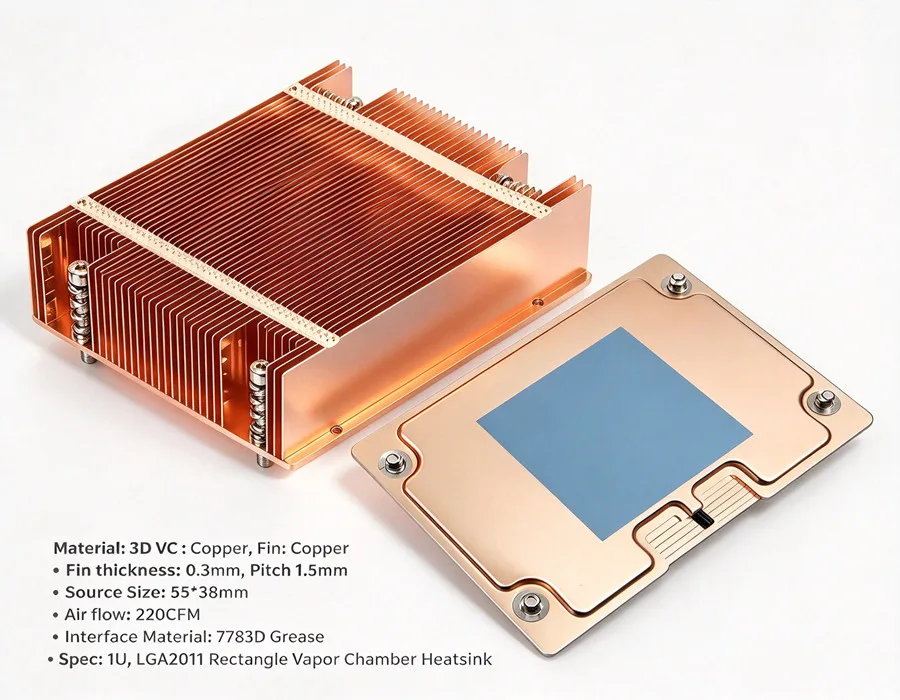
Learn key factors that influence heat sink design, including thermal requirements, structural considerations, and application constraints.
Understand how material selection impacts thermal performance, weight, and manufacturing considerations.
Compare different heat sink approaches and design options to identify suitable solutions for specific applications.
Explore common surface treatments and finishing options used to improve durability, appearance, and product performance.
Every thermal project has unique requirements, from product specifications and material selection to manufacturing processes and production volumes.
Falcon HeatTech provides engineering expertise and flexible manufacturing support to help customers turn thermal design concepts into production-ready components. Whether you are developing a new product, validating a prototype, or seeking a reliable OEM manufacturing partner, our team is ready to support your project from initial evaluation to production.
Send us your drawings, technical specifications, and estimated order quantity to discuss your project requirements and request a quotation.

A custom heat sink is a cooling component designed and manufactured according to specific application requirements, including thermal performance, size limitations, installation conditions, and product specifications. Unlike standard heat sinks, custom designs allow engineers to optimize cooling performance and mechanical integration for specific applications.
To evaluate a custom heat sink project, customers typically provide information such as application requirements, heat load, operating conditions, available space, mechanical constraints, and production expectations. Falcon HeatTech works with customers to review these requirements and recommend suitable design approaches.
Yes. Falcon HeatTech provides engineering support throughout the custom heat sink design process, including requirement evaluation, design review, material consideration, and manufacturing feasibility analysis.
Yes. Falcon HeatTech supports prototype development, small batch production, and low-volume manufacturing for customers who need design validation, product testing, or specialized production requirements.
Material selection depends on thermal requirements, weight considerations, operating environment, and manufacturing needs. Falcon HeatTech evaluates material options based on each project’s requirements to help customers achieve the right balance between performance and production feasibility.
Yes. Falcon HeatTech works with OEM customers to provide custom heat sink development and manufacturing support, from initial design stages through production supply.
We will reply you within 24 hours to bring you the best price and service!